
Bridges
Bridge health monitoring
Instruments on the structure, software that reads them hundreds of times a second, and people who act on what they show. We monitor the Chenab Bridge, the world's highest railway arch bridge.

Case study · Tranz Rail Solutions
The bridge
The Chenab Bridge carries the Udhampur–Srinagar–Baramulla rail link across the gorge of the Chenab river between Bakkal and Kauri, in Reasi district of Jammu and Kashmir. Its deck stands 359 m above the river bed, higher than the Eiffel Tower, and its steel arch spans 467 m. The Prime Minister opened it on 6 June 2025, connecting the Kashmir Valley to India's rail network.
It was built for Northern Railway by Konkan Railway Corporation, with Afcons as the main contractor. It is designed for winds of up to 266 km/h, for earthquakes of India's highest seismic zone, and, for the first time in India, for blast loads. It is designed to last 120 years.
- Above the river bed
- 359 m
- Main arch span
- 467 m
- Total length
- 1,315 m
- Design wind speed
- 266 km/h
- Design life
- 120 years
- Opened
- 6 June 2025
The challenge
Why it needs watching
A bridge this high, in this place, is exposed to almost everything nature can do. Strong winds funnel through the gorge. Temperatures swing widely between summer and winter, and the steel grows and shrinks with them. The region is seismically very active, the slopes the foundations sit in are steep, and the site is remote.
Trains are not allowed onto the bridge when the wind is too strong. Someone has to know, at every moment, how hard the wind is blowing, and how the bridge is responding to the trains, the weather and the ground. That is the job of the structural health monitoring system.
The system
What we installed
With JF SME Testing (formerly Strainstall Middle East), our group company Tranz Rail Solutions installed the bridge's complete structural health monitoring system. More than 200 sensors on the arch, the deck, the piers and in the ground around the foundations measure the loads on the bridge and how the structure and its foundations respond.
- Strain gaugesOn the arch, trestles and deck, measuring stress at chosen points up to 1,000 times a second.
- AnemometerAn ultrasonic wind sensor high above the middle of the main span, measuring wind speed and direction, with no moving parts to wear out.
- AccelerometersOn the deck, measuring vibration in three directions, from which the bridge's natural frequencies and stiffness are tracked.
- TiltmetersOn the tall piers, watching their inclination along and across the bridge.
- Displacement sensorsAt the bearings, measuring how the deck moves against the piers, to show the bearings are working.
- Temperature sensorsIn the air and on the steel, so movement can be matched to temperature.
- Seismic sensorsIn the arch foundations, to pick up any ground tremor.
- Extensometers and load cellsIn the ground and the rock anchors, watching for movement and load around the foundations.
- GNSSSatellite positioning of the deck, to measure its position and deflection.
From sensor to signal
How it works
- MeasureData loggers on the bridge read every sensor and turn the raw signals into engineering units.
- Bring it togetherA fibre-optic network carries the data to the control room near the Bakkal end of the bridge, where SAMS, JF SME Testing's Smart Asset Management System, brings it all together at hundreds of samples per second.
- Watch and warnSAMS checks the readings in real time. When the wind passes the limit for running trains, the signal turns red and an alarm sounds in the station master's room.
- Analyse every eventA high wind or a tremor sets every sensor sampling at its fastest, and an analysis of how the bridge responded is produced automatically.
Timeline
From installation to handover
In February 2024, after a successful trial watched by railway engineers in the control room, the system was handed over to the railway authorities, and our partners trained the team who run it. Since the bridge opened in June 2025 the system has been watching over it in service. The Railway Minister has visited the monitoring control room, and we are contracted to monitor the bridge for five years.
Working on Chenab has pushed us to ask hard questions: how to build systems that do not just report, but predict, and how what we learn here can help bridges in less dramatic but equally important places.
- System handed over
- February 2024
- Bridge opened
- 6 June 2025
- Monitoring contract
- 5 years
- Software
- SAMS (JF SME Testing)
Services
Monitoring for your structures
We bring the same approach to other bridges and structures: bridge health monitoring and camber monitoring through instrumentation, with the data brought together in JF SME Testing's SAMS software so engineers can see how a structure is behaving and act early. We work with JF SME Testing, whose team has monitored landmark bridges around the world.
Related
 BridgesRiver-bed scanning3D scanning of river beds under and around railway bridges.
 TestingPhased array testingKalmar weld testing and Fazar rail testing, with an AI second read of every scan.
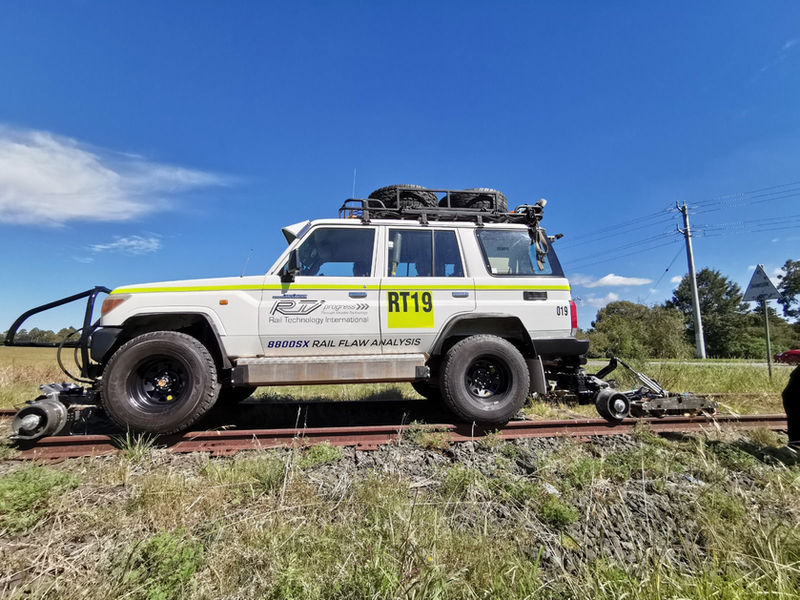 Testing and inspectionRail-cum-road vehiclesThe RCRV ultrasonic testing vehicle and the RCRIV inspection vehicle.
Planning monitoring for a bridge or structure? Tell us about it.
Ask about bridge monitoring